Bergen is the second largest city in Norway with a population of 270,000. We went on a panoramic tour of the city partly in the rain. Bergen has more rainy days than sunny with an average of 260 a year; but as our tour guide said, “There is no bad weather in Bergen, only bad clothing.”
The most iconic landmark of Bergen is the historic wooden buildings of the UNESCO Bryggen wharf. There are three ships lining the harbor which are among the oldest and best preserved sailing ships in Norway.

Some American companies have repurposed the old buildings in Bergen. Below is a local Starbucks. If you click on the image to enlarge it, you can easily see its name in the middle of the photo.

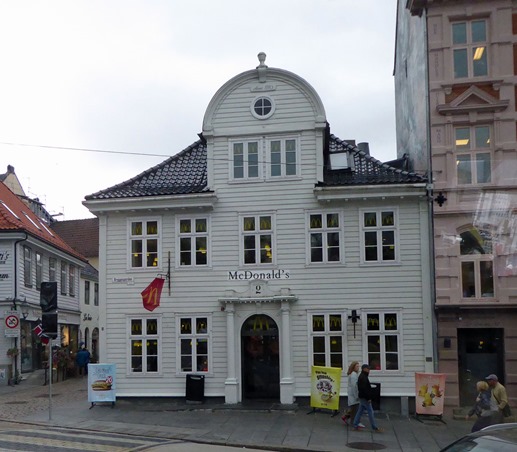
And here is a McDonalds occupying one of the old wooden buildings.
After our city tour, we took another excursion to visit Fantoft Stave Church. Stave churches are considered to be among the most important examples of wooden Medieval architecture in Europe. In the Middle Ages, there were probably more than 1,000 stave churches in Norway. Today, only 28 remain. The decoration is a fascinating mix of both Christian and Viking symbolism.

The entire church is built without using any nails. The inside surfaces are covered with bee’s wax to preserve the wood.

The exterior or the Stave church is preserved using tar. This church was originally built around 1150. It was moved piece by piece to Fana near Bergen in 1883 to save it from demolition. In 1992, the church was destroyed by arson. It took six years for artisans to meticulously restore it to its former beauty.

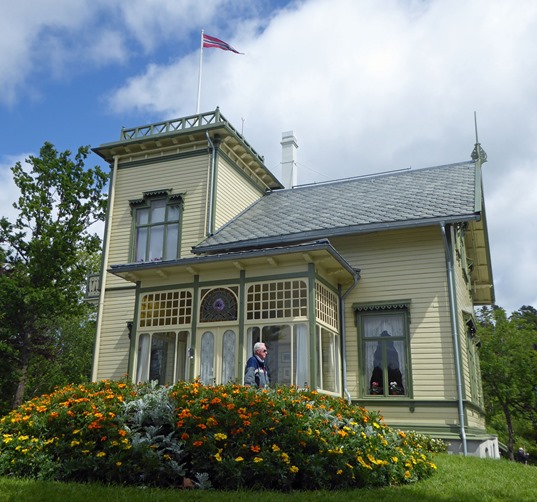
Edvard Grieg (June 15, 1843 – September 4, 1907), was a Norwegian composer and pianist and is the most celebrated person from the city of Bergen. This afternoon, we visited Troldhaugen, his home for 22 years.
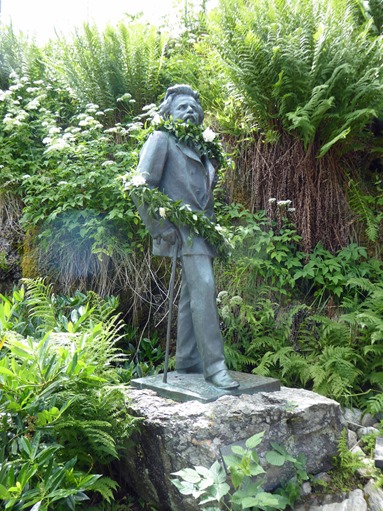
The property also has a museum and concert hall. This is a statue of Grieg next to the concert hall, one of many found throughout Bergen. The garland around his statue is in celebration of his June birthday.
The concert hall has a unique roof found on an occasional building in Norway. The first layer of the roof is wood which is followed by birch bark because of its water proofing chemicals. The third layer is turf which serves as insulation. The grass just grows naturally. An undesirable bush or tree can sometimes be found growing on the roof. Goats or sheep can be put on the roof to keep it trimmed. The roof usually last about 20 years.

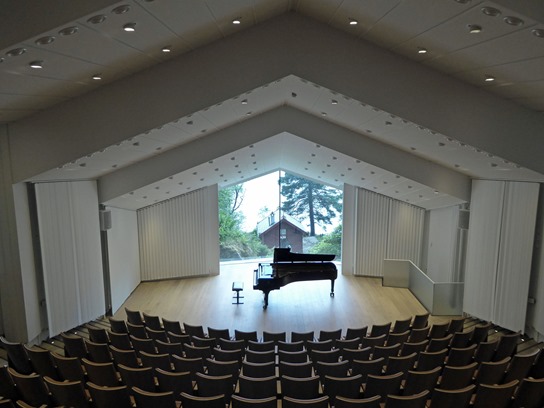
After we explored inside Grieg’s home, we went into this lovely concert hall and were treated to a concert. The red cabin in the background is where Grieg composed his music, and behind that is water.
Tomorrow morning, our cruise comes to an end; and we fly to Reykjavik, Iceland.

Have so enjoyed seeing the photos and reading the descriptors (+ learning lots!) Good luck with the packing.
ReplyDelete